How Much Do I Need for a Down Payment on a House in Utah?

For a median-priced $574,000 Utah home in 2026, buyers need between $0 and $20,090 for a down payment. Eligible veterans and rural purchasers can buy with 0% down, while first-time buyers utilizing FHA or conventional loans typically require just 3% to 3.5%.
Introduction: Overcoming the 20% Myth
Purchasing a home in the Beehive State can feel overwhelming, especially when looking at current property values and reading national headlines. A persistent myth suggests that buyers must save a massive 20% down payment before even thinking about homeownership. For a typical median-priced home, that would mean saving well over $100,000—a discouraging and often impossible number for the average family.
Fortunately, the reality of the 2026 real estate market is much more forgiving. With the market finally cooling from the chaotic bidding wars of recent years, and with numerous state and local assistance programs available, homeownership is highly achievable. Buyers have far more leverage and financial support than public perception suggests. This report explores exactly what capital is required to secure a home in Utah today.
The 2026 Utah Market: Normalizing, Not Crashing
To fully understand down payment requirements, it is essential to understand the current housing climate. Utah is not experiencing a housing crash; rather, it is normalizing. The days of frantic, over-asking-price offers are largely in the rearview mirror. Today, only about 15% to 16% of homes sell above their asking price.
The median home price in Utah currently sits around $574,000, representing a modest, stable growth of about 1.8% over the past year. Active listings have increased significantly, with over 26,700 homes available statewide, giving buyers more choices than they have had in years. Homes are staying on the market longer, with the median days on market rising to 53 days statewide.
Because properties are sitting slightly longer, buyers have regained critical negotiating power. Sellers are much more willing to offer concessions, such as helping cover closing costs or contributing funds to lower the buyer's mortgage interest rate. This shift makes it significantly easier for buyers to hold onto their savings when finalizing a deal.
Breaking Down the Actual Down Payment Numbers
The required down payment depends entirely on the type of mortgage a buyer chooses. Below is a breakdown of what a down payment actually looks like for a typical $574,000 Utah home.
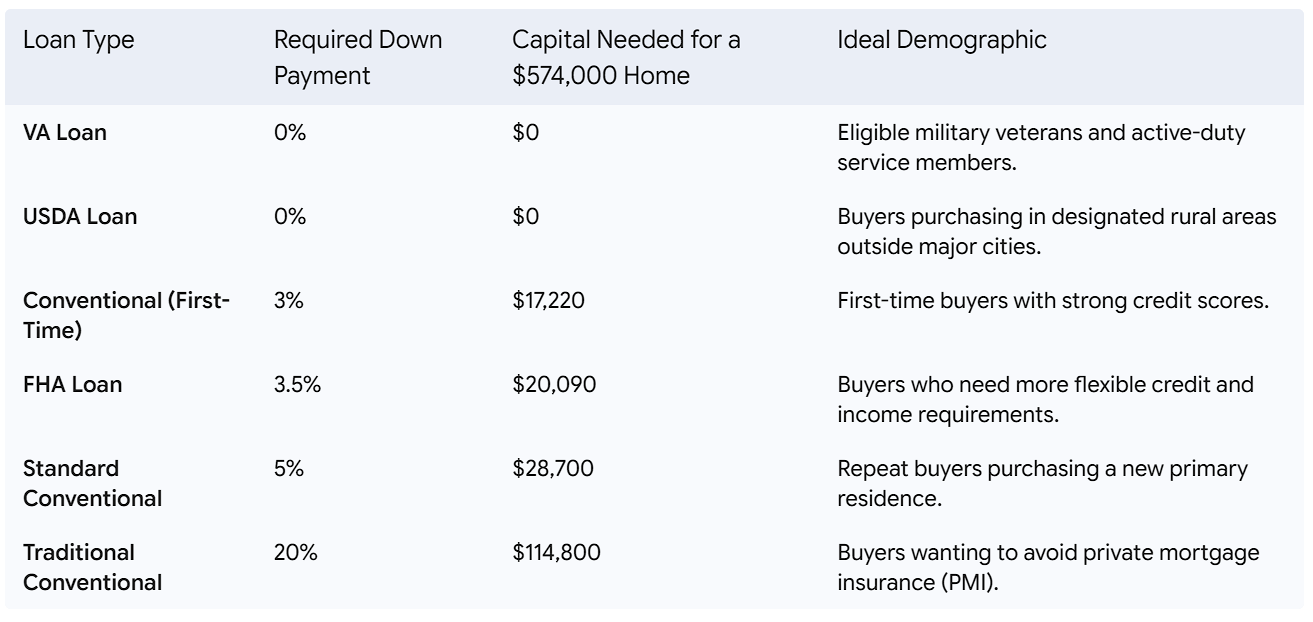
As the data illustrates, the majority of first-time buyers only need to save between $17,000 and $20,000 to enter the market. While a 20% down payment is excellent for lowering monthly obligations and avoiding mortgage insurance, it is absolutely not required. Furthermore, buyers utilizing zero-down options like VA loans can step into a home for little more than standard closing costs, which can often be covered entirely by seller concessions in today's market environment.
Utah Down Payment Assistance Programs
Even a $20,000 requirement can be a high hurdle when the median rent in Utah remains around $1,800 per month. Thankfully, the state offers incredible down payment assistance (DPA) programs designed specifically to bridge this exact gap.
The $20,000 New Construction Boost (S.B. 240)
One of the most powerful tools available in 2026 is the First-Time Homebuyer Assistance Program. This state-funded initiative provides up to $20,000 for buyers purchasing a newly built home priced at $450,000 or less. This money can be used for the down payment, closing costs, or to permanently lower the interest rate. It carries a 0% interest rate, requires no monthly payments, and is only repaid when the home is eventually sold or refinanced.
Utah Housing Corporation (UHC) Loans
The Utah Housing Corporation offers programs that provide a second loan to completely or partially cover the down payment. The UHC FirstHome Loan provides up to 6% of the purchase price for first-time buyers with a credit score of at least 660. For those who have owned a home before but are looking to buy again, the UHC HomeAgain Loan also offers up to 6% in assistance, featuring highly flexible income limits up to $151,900 and no maximum purchase price limit.
Local and County Grants
Many buyers assume they make too much money to qualify for local grants, but income limits are often higher than expected. For example, Davis County offers a deferred loan program providing up to $50,000 in assistance for income-qualified buyers, requiring repayment only upon sale or refinance. Similarly, West Valley City offers a true $5,000 grant that never requires repayment, while West Jordan provides up to $7,500 that is completely forgiven after five years of living in the residence.
Navigating 2026 Mortgage Rates and Builder Incentives
A critical factor when budgeting for a home is the cost of borrowing capital. In May 2026, the average 30-year fixed mortgage rate reached 6.51%, driven by national economic factors and inflation. However, local lenders offer varying options, with some 15-year fixed rates hovering near 6.125%.
While rates are higher than they were a few years ago, waiting for them to drop can be a risky strategy. When rates eventually fall below 6%, a flood of sidelined buyers is expected to re-enter the market. This surge in competition could drive home prices up and completely eliminate the current negotiating power buyers enjoy. Instead, many buyers are choosing to purchase now, asking sellers to pay for a temporary or permanent interest rate buy-down, with the intention to refinance when average rates improve.
Additionally, the new construction sector is offering unprecedented financial opportunities. Builders in growing communities are highly motivated to sell their completed inventory. To attract buyers, builders frequently cover total closing costs and offer their own financing incentives to buy down the mortgage rate significantly below the 6.51% state average. When a buyer stacks a builder’s rate buy-down with the $20,000 state grant from the First-Time Homebuyer Assistance Program, a brand-new home becomes incredibly affordable, requiring minimal upfront cash.
Conclusion
The path to homeownership in Utah is vastly more accessible than it appears on the surface. With the market stabilizing, flexible loan options requiring as little as 0% to 3.5% down, and generous state assistance programs, the dream of owning a home is well within reach for the average family. Understanding the local nuances of state grants, builder incentives, and rate buy-downs is the ultimate key to a successful property purchase.
For expert guidance and a true partnership in the home buying journey, reach out to the professionals who know Utah best. Contact The Buckway Group today to schedule a consultation, explore new construction opportunities, and start the path toward a dream home.
Phone: +1 (801) 900-3366
Email: [email protected]
Office: 1085 W 9000 S Suite 200, West Jordan, UT 84088
Hours: Monday through Saturday, 8:00 AM – 8:00 PM